Options
Why the Same Greeks Are Calm on Apple and Lethal on Nebius
The Greeks aren't abstract — they're the dials behind every covered call and put in this series. The surprise is that the one everybody watches, delta, is nearly identical on Apple and Nebius. It's the other four that explain why the same trade is a yield on one name and a grenade on the other.


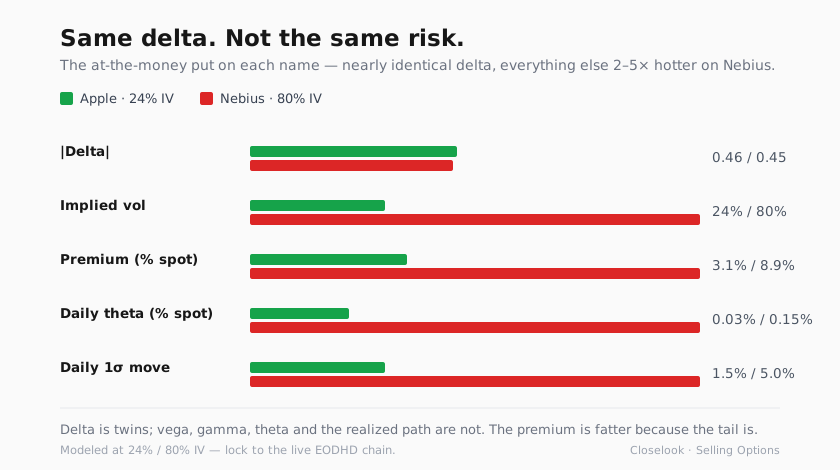
As of late May 2026, Apple trades near $308 with implied volatility in the low 20s; Nebius, the NVIDIA-backed AI-infrastructure name, trades near $214 with implied vol in the 80s. Write the same at-the-money put on each and the position looks, by its headline number, almost identical — both sit around a 0.45 delta. Yet one is a quiet income trade and the other can hand you a 25% loss in a single month. The gap between them is the whole reason to learn the Greeks. They are simply the dials that tell you how a position will behave when the world moves, and on these two names the dials could not read more differently.
Delta — the dial you already know
Delta is the option's sensitivity to the stock: how much its value changes for a one-dollar move. For a put it runs from 0 to −1, and its magnitude doubles as a rough read on the odds the option finishes in the money — which, for a seller, is the probability of assignment. That's the dial from the divide piece: a 0.20-delta put is the never-own harvest, a 0.85-delta put is the own-it-cheaper commitment. Here's the part that surprises people: the at-the-money put on Apple and the one on Nebius carry almost the same delta — 0.46 against 0.45. If delta were the whole story, the two trades would be twins. They are not. Delta tells you where you stand today; it says nothing about how hard the ground is about to move.
Theta — the wage the seller collects
Theta is time decay — the value an option sheds with each passing day, all else equal. For the buyer it bleeds against them; for the seller it accrues, which is why theta is the premium seller's wage. The two names pay that wage at wildly different rates. Apple's at-the-money put bleeds roughly 0.03% of the share price a day; Nebius's bleeds about 0.15% — four to five times faster. That faster decay is the fat premium from the divide piece, seen from the inside: you're paid more per day on Nebius because there's more time value to melt. Theta also accelerates as expiry nears, fastest of all on at-the-money strikes — which is why the seller's edge concentrates in the final weeks, and why the 30–45 day window keeps recurring across these strategies.
Vega — the dial that bites on fear
Vega is the position's sensitivity to implied volatility itself. A seller is short vega: you make money when IV falls and lose when it rises. The danger on a name like Nebius isn't only that vega is large — it's the vol-of-vol, how far implied volatility can itself leap. Apple's IV drifts a few points around earnings and settles. Nebius's can vault twenty, thirty, forty points on a single headline, and every one of those points reprices the option you are short, against you, instantly. This is the dial behind the earnings-window warning: implied vol balloons into the event, the print gaps the stock, and then IV collapses — a sequence that punishes the seller coming and going if it's mistimed. On a calm name vega is a background hum; on a violent one it's the fault line.
Gamma — why big moves hurt the seller
Gamma is the rate at which delta itself changes as the stock moves, and it's highest at-the-money and as expiry approaches. The seller is short gamma, and short gamma is the structural discomfort of the whole trade: as the underlying falls your delta grows more negative — you get longer exactly as it drops — and as it rises you get shorter, the wrong way each time. On Apple this drift is gentle and manageable. On Nebius, where a 5%-a-day move is ordinary, gamma swings your exposure violently between hedges; your position turns against you faster the more the stock moves. Gamma is the engine under the tail in the risk piece — the reason a big gap doesn't just hurt, it hurts more than proportionally.
Rho — the footnote
Rho measures sensitivity to interest rates, and for the short-dated options these strategies use, it's the dial you can mostly ignore. It matters at the margin: higher rates lift call prices and trim put prices, and on the cash-secured put the cash you set aside earns the prevailing rate, which belongs in the honest yield comparison from the accumulation piece. Beyond that, on a 30- to 45-day option, rho is a rounding error next to the other four.
The master dial: implied volatility
Step back and one number runs all of it. Implied volatility scales the premium you collect, the vega you carry, and — through the size of the moves it implies — the practical force of both gamma and theta. Apple at 24% and Nebius at 80% isn't a detail; it's the explanation. Every dial that makes Nebius lethal is the same dial that makes its premium look so generous. The richness and the danger are not two facts. They are one number, read two ways.
One question worth sitting with
The Greeks are a live snapshot of the risk the chain is pricing this minute — and on a calm name they barely twitch, while on a violent one they reprice in hours. So the question for any premium seller is whether you're actually watching the Greeks you're short — the vega that inflates the instant fear arrives, the gamma that turns your own delta against you — or only the premium you booked on the day you sold, which feels like the whole story right up until it isn't. The dials were telling you the truth the entire time; the only question is whether you read them. The Money Temperature monitor helps frame whether implied vol is more likely to compress or expand from here — which, for someone short vega and short gamma, is the difference between the calm gauge and the trembling one.
Closelooknet publishes a market diary, not investment advice. The strategies described here are educational. Tax, suitability, and risk depend on personal circumstances — consult a licensed advisor before acting.