Options
Sell to Own, or Sell to Never Own — The One Decision Behind Every Put
A sold put is one instrument that does two opposite jobs. Whether assignment is your win or your failure — and which strike expresses it — is the whole game. The same put pays 9% on Apple and 41% on Nebius, and the gap tells you exactly what you're being paid for.


As of late May 2026, Apple sits near an all-time high around $308 with implied volatility in the low 20s, while Nebius — the NVIDIA-backed AI-infrastructure name — trades near $214 after running roughly tenfold off its post-spinoff base of about $20, with implied vol in the 80s. Sell a put on each at the same odds of assignment and one pays about 9% annualised, the other about 41%. Same instrument, same probability of being left alone, nearly five times the premium. Understanding why is the single most useful thing a premium seller can know, and it starts with a decision most people never consciously make.
The same trade, two opposite intentions
A sold put is one mechanic that does two completely different jobs depending on why you sold it. The intention — and the strike you choose to express it — is everything.
Goal one is to own the stock cheaper. You'd be happy to hold the name. You sell a put at a price you'd gladly pay; if the stock falls to it, you're assigned and you own what you wanted, at a discount, premium included. Here assignment is the win. The put is a paid limit order. This is the logic of the cash-secured put as an accumulation tool.
Goal two is to never own the stock — to collect premium continuously. You don't want the shares at all. You want every option you sell to expire worthless so you can sell another one next month, and again the month after. Here assignment is the failure, expiry worthless is the win, and the strategy is a treadmill of small, repeated harvests.
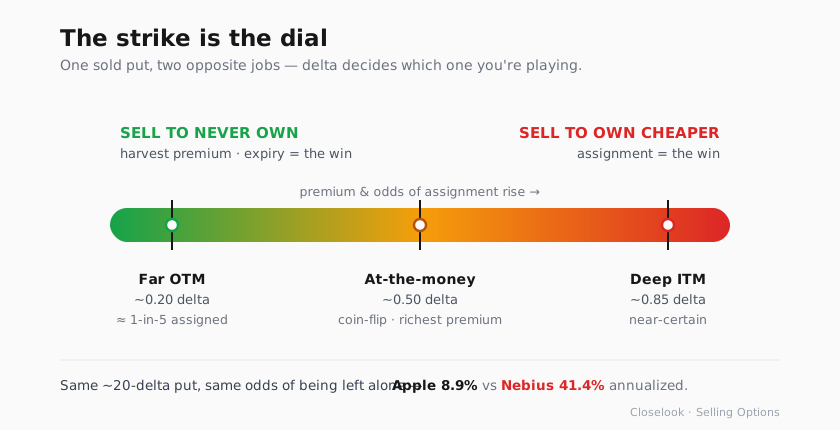
Two goals, opposite definitions of success, identical sold put. What separates them is the strike — and the strike, expressed as a Greek, is delta.
The strike is the dial
Delta does double duty. It's the option's sensitivity to the stock, and its magnitude is roughly the market's odds that the option finishes in the money — that you get assigned. So the strike you pick is a direct statement of which goal you're playing. A far out-of-the-money put, around 0.20 delta, has roughly a one-in-five chance of assignment: the never-own harvester's home. An at-the-money put, around 0.45–0.50 delta, is a coin flip and pays the richest premium per day of any strike: the greedy middle. A deep in-the-money put, around 0.70–0.90 delta, is near-certain assignment: the own-it-cheaper extreme, where the premium — mostly intrinsic value — is the cushion you collected for committing. Far OTM says "pay me and leave me alone." Deep ITM says "I want this stock, pay me to commit." The dial runs continuously between them.
What it pays — Apple, the calm end
Apple near $308, low-20s implied vol, a 45-day put. The annualised figures below are the gross yield if the put expires worthless — premium over the cash you secure, scaled to a year — which is the headline a harvester quotes; read it as a ceiling, not a realised return.
| Strike | Distance | Put premium | Delta (≈ assignment odds) | Annualised if worthless | If assigned, you own at |
|---|---|---|---|---|---|
| $290 | 6% OTM | $3.17 | 0.21 | 8.9% | $286.83 (−6.9%) |
| $308 | at-the-money | $9.59 | 0.46 | 25.3% | $298.41 (−3.1%) |
| $340 | 10% ITM | $32.14 | 0.86 | 76.7% | $307.86 (≈ market) |
The $290 put is the never-own harvest: a one-in-five chance of assignment, a steady ~9% for selling calm. The $340 put is the own-it-cheaper extreme: you'll almost certainly be assigned, and because the premium is nearly all intrinsic, the "discount" collapses to roughly the time value — you're committing to buy Apple at about today's price, paid a thin kicker for the certainty.
What it pays — Nebius, the fat end
Same three strikes on Nebius near $214, implied vol in the 80s, 30-day puts:
| Strike | Distance | Put premium | Delta (≈ assignment odds) | Annualised if worthless | If assigned, you own at |
|---|---|---|---|---|---|
| $182 | 15% OTM | $6.20 | 0.20 | 41.4% | $175.80 (−17.9%) |
| $214 | at-the-money | $19.13 | 0.45 | 108.8% | $194.87 (−8.9%) |
| $246 | 15% ITM | $40.07 | 0.68 | 198.2% | $205.93 (−3.8%) |
Put the two out-of-the-money rows side by side and the whole piece is in the comparison. Apple's 6%-OTM put and Nebius's 15%-OTM put carry roughly the same assignment odds — both near a 20-delta, both expire worthless about four months in five. Apple pays 8.9% for that. Nebius pays 41.4%. Almost five times the premium for the same probability of being left alone.
That extra thirty-odd points is not a gift, and it isn't an inefficiency you've spotted that the market hasn't. It's the market quoting you, exactly, the price of the tail. The premium is high because the chance of a violent move is high — the model prices it that way on purpose. You're paid more because you're carrying more.
What the annual numbers actually mean
Treat those yields with care. They're gross, pre-tax, and conditional on the put expiring worthless. An at-the-money put is assigned roughly half the time, so the 25% or 108% never compounds cleanly — it's interrupted by assignment. Premium is short-term income (top-bracket in the US, roughly 26% Abgeltungsteuer plus surcharge in Germany), and thin chains add slippage on every roll. And the headline figure ignores the one thing that decides whether you keep any of it: the tail. The Greeks behind all of this — why Nebius's premium is so fat and so dangerous — are in Why the Same Greeks Are Calm on Apple and Lethal on Nebius. What the tail actually does to a seller is in Win Small, Often. Lose Big, Once.
Closelooknet publishes a market diary, not investment advice. The strategies described here are educational. Tax, suitability, and risk depend on personal circumstances — consult a licensed advisor before acting.