Read · · 8 min read
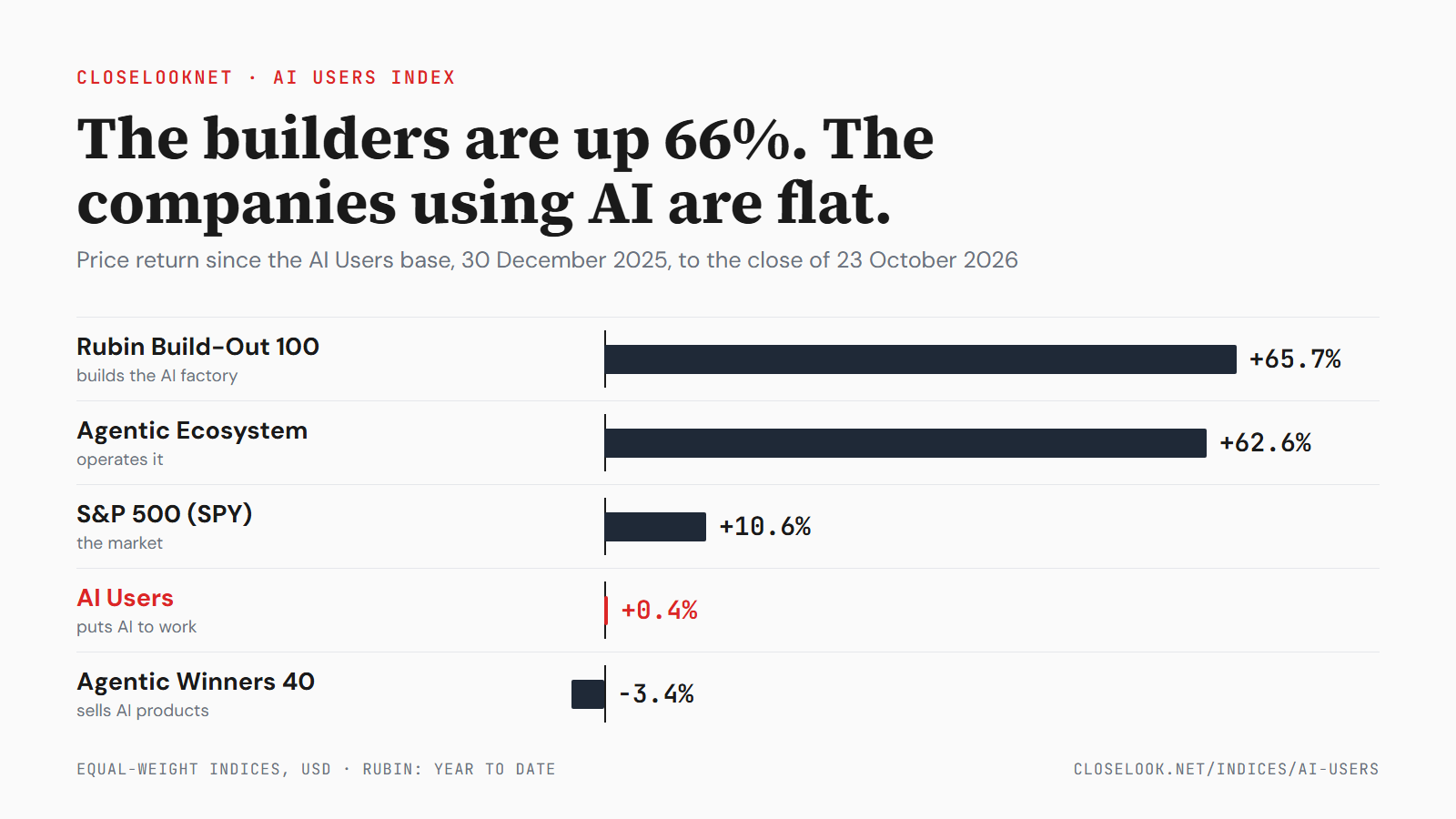
A new Closelooknet index of 32 large caps that put AI to work inside businesses they already run: seven sections, dated evidence for every name, base 1,000 on 30 December 2025 — and our read of why the payoff has not reached the share price yet.

A Lab Read on the fifth Closelooknet functional index. Diary framing throughout: this is how we built the index, how we read it and what we watch, not what anyone should do with it. Every company figure below comes from the company’s own filings, calls or releases, dated, and is listed in the evidence register behind the index.
What AI Users measures
Most of the money made from AI in 2026 went to the companies that build it. The Rubin Build-Out 100, our index of the AI factory — chips, memory, power, cooling — is up about 66% this year. The Agentic Ecosystem, which tracks the companies that run AI as a service, is up about 63%.
AI Users asks a different question: which companies are putting AI to work inside a business they already run, and does it show up in their numbers? An insurer that lets models draft every damage estimate qualifies. A retailer whose AI plans the routes of its own trucks qualifies. A company whose product is AI does not — that is what Agentic Winners 40 tracks.
The index holds 32 large caps in seven sections, from claims handling to drug discovery. It is equal weighted, priced in US dollars and based at 1,000 on 30 December 2025. Since then it has moved +0.4%, while the S&P 500 is up 10.6%.
Inside this study
- Seven ways AI pays inside a business — the sections and who sits in them.
- The evidence test — what a company has to show to get in.
- Point in time — why only evidence published by the base date counts.
- What the prices say so far — sections, regions and the gap to the builders.
- Why the payoff can lag — our read of the gap, and the first numbers on it.
- How the index is run — reviews, entry, exit.
- What we watch — the readings that would change our view.
Seven ways AI pays inside a business
We sorted the companies by what AI does inside them, not by industry. A bank and an insurer can sit in the same section if AI makes the same kind of decision in both. That keeps the question in view: where in a business does AI earn its keep first?
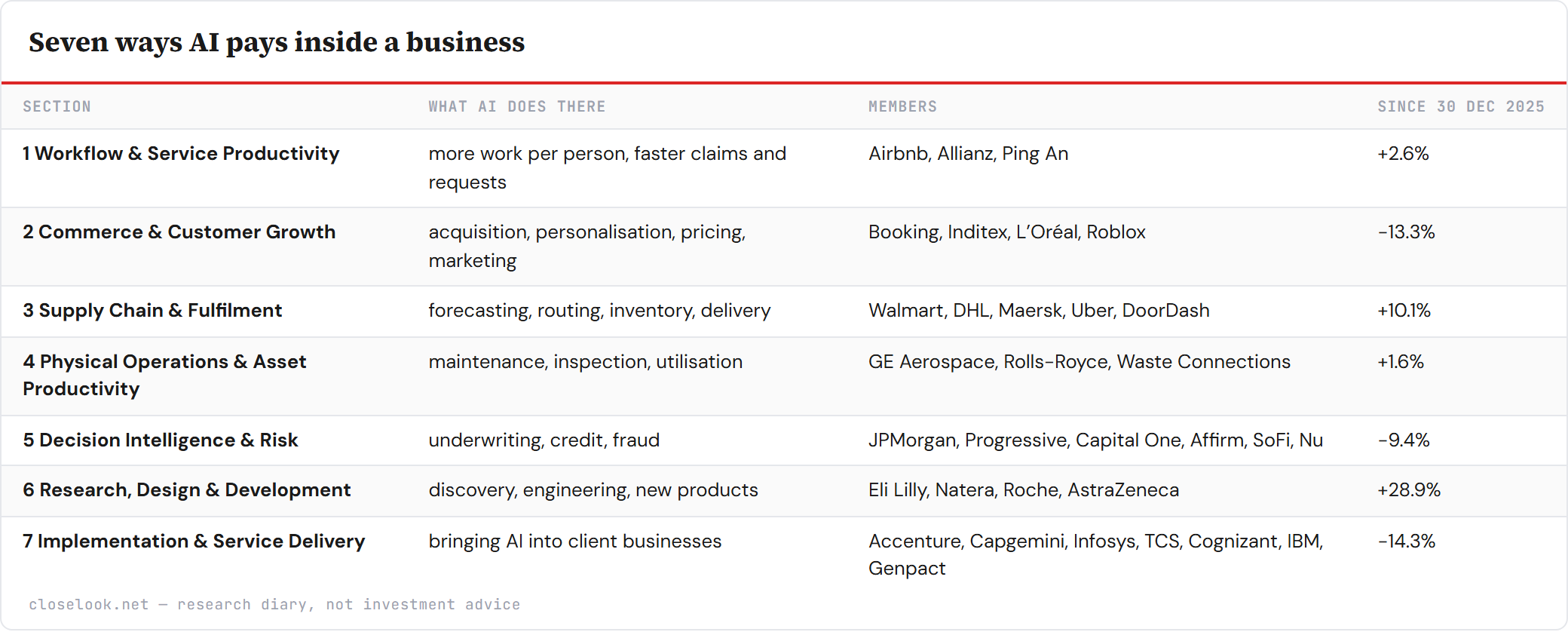
Table as text
| Section | What AI does there | Members | Since 30 Dec 2025 |
|---|---|---|---|
| 1 Workflow & Service Productivity | more work per person, faster claims and requests | Airbnb, Allianz, Ping An | +2.6% |
| 2 Commerce & Customer Growth | acquisition, personalisation, pricing, marketing | Booking, Inditex, L’Oréal, Roblox | −13.3% |
| 3 Supply Chain & Fulfilment | forecasting, routing, inventory, delivery | Walmart, DHL, Maersk, Uber, DoorDash | +10.1% |
| 4 Physical Operations & Asset Productivity | maintenance, inspection, utilisation | GE Aerospace, Rolls-Royce, Waste Connections | +1.6% |
| 5 Decision Intelligence & Risk | underwriting, credit, fraud | JPMorgan, Progressive, Capital One, Affirm, SoFi, Nu | −9.4% |
| 6 Research, Design & Development | discovery, engineering, new products | Eli Lilly, Natera, Roche, AstraZeneca | +28.9% |
| 7 Implementation & Service Delivery | bringing AI into client businesses | Accenture, Capgemini, Infosys, TCS, Cognizant, IBM, Genpact | −14.3% |
Equal-weight section indices, USD, price return to the close of 23 October 2026.
Seven names are implementers — Accenture, Capgemini, Infosys, Tata Consultancy Services, Cognizant, IBM and Genpact. They earn by bringing AI into other companies, and they use it in their own delivery. They are the bridge between the builders and the users, which is why they sit in a section of their own.
Five names are also members of HALO, our growth index; overlap is capped at a fifth. No member sits in Rubin, the Agentic Ecosystem or Agentic Winners 40, so the five indices do not double count.
The evidence test
Every company gets an adoption score from 0 to 4. A 2 means AI is in production in a core process, with the scope, a number and a date — not a pilot and not a slide. A 3 means the company lets AI act, not only answer, and management ties it to a cost or revenue line. A 4 means AI acts in several processes with a financial benefit measured in two reporting periods.
Some examples from the register, each with its own source. JPMorgan Chase said at its May 2025 investor day that about 80% of its auto-loan credit decisions are automated, and it has tied its AI programme to a stated business value in several years. Ping An reported that AI service agents handled about 80% of its customer-service volume in 2024, and its AI fraud screening saved RMB 11.94 billion in claims that year.
Progressive told investors in March 2025 that machine-vision models draft every photo damage estimate, which adjusters then check, and put the 2024 gain at about 200 staff it did not need to hire. Walmart’s AI route planning had removed 30 million unnecessary miles from its own fleet by March 2024. Accenture booked $2.7 billion of revenue from advanced AI in its 2025 fiscal year, three times the year before.
Of the 32 members, two score 4, nine score 3, eighteen score 2 and three score 1. A claim without a scope or a number stops at 1, however large the announcement. That is our guard against AI-washing.
Point in time
An index built today with today’s knowledge would pick the companies whose AI stories have already worked, and its history would look better than anything an investor could have held. So the starting members are judged only on evidence published by 30 December 2025, the base date. What was published later counts at the first review after it.
Three members did not meet that bar at the base: Inditex, Capital One and SoFi. Their AI work before the base was real but not measured in public — SoFi’s own annual report calls its use of AI limited. They are marked PIT on the index page and stay until the November 2026 review decides.
What the prices say so far
Since the base the equal-weight index is +0.4%, the cap-weighted version −0.9% and the momentum version +0.2%. The S&P 500 (SPY) is up 10.6% and developed and emerging markets outside the US (VEU) 9.2%. The builders and operators are up more than 60%.
Inside the index the spread is wide. Research & Development — Eli Lilly, Roche, AstraZeneca and Natera — is up +28.9%; Supply Chain is up +10.1%. Commerce is −13.3% and Decision Intelligence −9.4%.
The implementers are −14.3% since the base, in a year when many investors worried that AI would shrink what companies spend on IT services. Over the past month they are up +22.3%. By region, Europe is +12.3%, the Americas −1.0% and Asia −26.0%, where Ping An, Infosys and TCS sit.
Why the payoff can lag
Our read is that markets pay for capacity before they pay for use. The chain runs in steps: a company hires the people to deploy AI, the system goes live three to six months later, an operating figure moves six to twelve months after that, and the income statement shows it after twelve to twenty-four. In our reading, the builders’ share prices move at the first step and the users’, if at all, at the last.
The second reason is that the benefit can be passed on. A retailer that lowers its costs with AI can lower its prices too, and then the gain shows up in volume, not in margin. Walmart is the textbook case: between its fiscal years 2021 and 2026 revenue per employee rose about 40%, while the operating margin moved from 4.0% to 4.2%. We call this the retention test, and the index will score it.
We measure the benefit with two figures, each against the company’s own industry: how much faster revenue grows than headcount, and whether the operating margin keeps up. A first read at the base date, before the November review assigns any stages: JPMorgan’s revenue per employee grew about 7.6% a year, about 3 points faster than the median bank; Walmart’s about 6.2% a year, close to 3 points ahead of its group. Accenture’s grew 0.3% a year, about 2 points behind the median of the IT-services peers we compare it with — the implementer still sells mostly hours.
How the index is run
Weights reset to equal at each quarter end. Members change only at a review, on the third Friday after each reporting season; the next is on 20 November 2026. Only evidence published by a review date counts at that review.
A company enters with an adoption score of 2 or higher and leaves when it falls to 1, or when its advantage over its industry has gone in two reviews running. A stage change needs two reviews to confirm it, so one quarter does not churn the index; a written-off AI programme is the exception and acts at once. Share-price performance plays no part in membership. The full rules are on the index page.
What we watch
Three readings would change our view. First, the November review: whether the benefit figures of the members pull away from their industries, or converge. Second, the implementers’ bookings, which by our estimate run six to eighteen months ahead of their clients’ results. Third, the hiring of deployment engineers, which our Forward Deployment Pulse tracks every weekday.
If the users’ numbers start to separate from their peers while the builders’ gains slow, the gap on the cover would be the place where that shows first. If it does not happen, AI Users will record that too. That is the point of building the index before the answer is known.
Sources
- Closelooknet AI Users evidence register, 32 members plus two reviewed names, every entry dated with its source; cutoff 30 December 2025.
- JPMorgan Chase, 2025 Investor Day presentation (Form 8-K, 19 May 2025). Ping An Insurance, audited results for 2024 (HKEXnews, 19 March 2025). Progressive, Q4 2024 investor event (4 March 2025). Walmart Commerce Technologies release (14 March 2024). Accenture, Q4 fiscal 2025 earnings call (25 September 2025). SoFi Technologies, Form 10-K for 2024.
- Index levels: Closelooknet index workers, closes of 23 October 2026; SPY and VEU from the Closelooknet data lake.
- Benefit figures: Closelooknet sector maturity atlas, fiscal years filed by 30 December 2025, EODHD fundamentals and 10-K headcounts.
- Closelook: AI Users index; AI Users 101; Rubin Build-Out 100; Agentic Winners 40; Forward Deployment Pulse; Forward-Deployed Engineers.